Trees are like us, natural organisms full of imperfections.
Trees develop hollows, shed bark, support fungi, lose branches and carry old wounds. To many people, these can look like signs that something is wrong.
Sometimes tree issues do warrant further investigation but often they’re just features of mature trees.
One of the most valuable things an arborist can do is recognise the difference between a genuine concern and a feature that’s normal, expected or insignificant.
Here are five things that often worry people but aren’t necessarily a problem.
1. Hollows
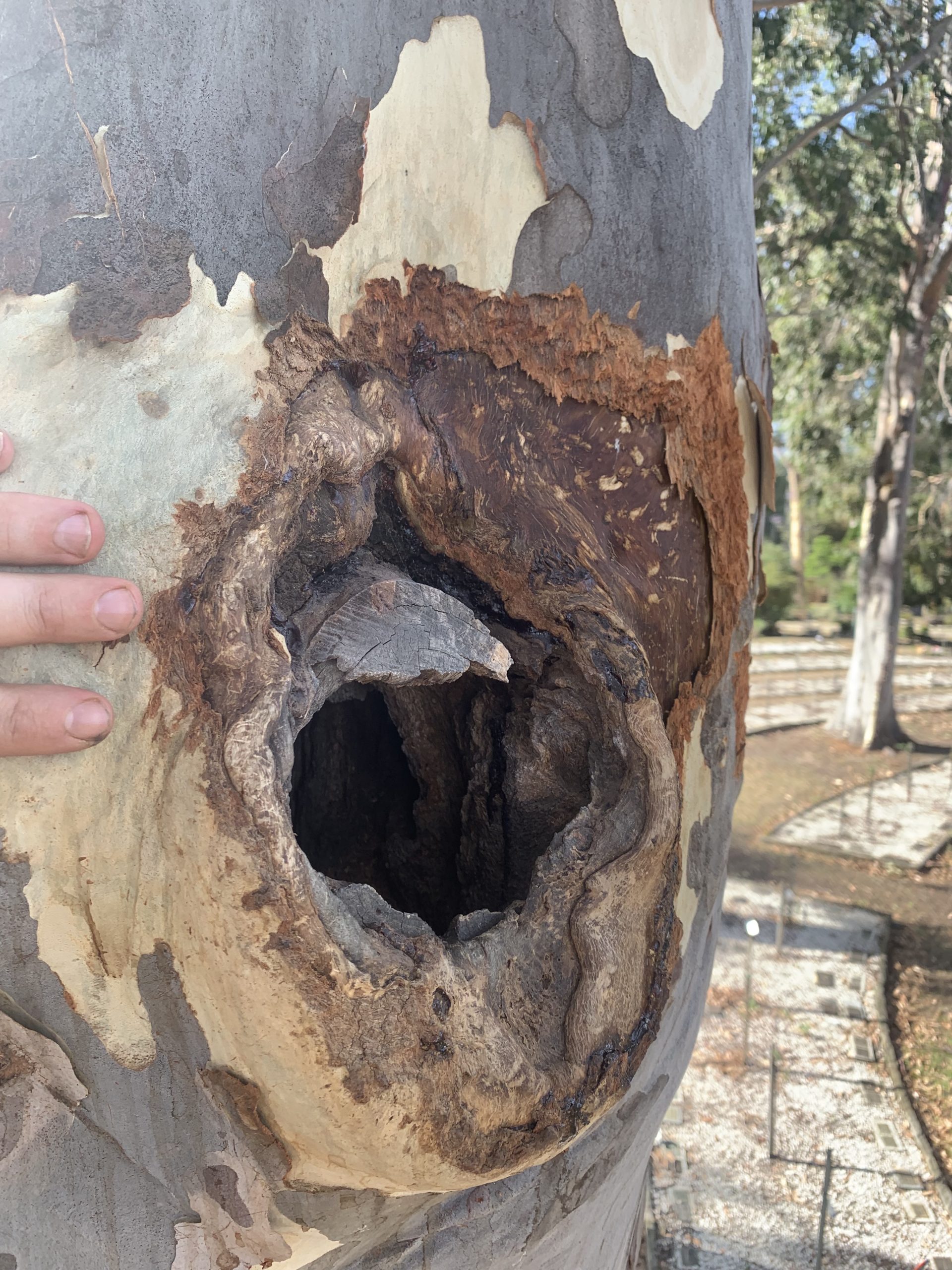
Few tree features cause more concern than a hollow.
Many people assume that a hollow tree is a dangerous tree, but that’s usually not the case.
Trees can compartmentalise decay, meaning a hollow may remain stable while the surrounding wood continues to provide adequate strength and support.
Furthermore, hollow trees are often some of the most valuable trees in the landscape. In the Blue Mountains, they provide critical habitat for a range of native wildlife, including parrots, cockatoos, possums and gliders.
A hollow can increase the likelihood of failure in some situations, but the presence of a hollow alone tells us very little. Size, location, extent, tree species, occupancy and many other factors all matter.
A hollow may be a reason to investigate further and by itself is not a reason to remove a tree.
2. Fungi
Finding mushrooms or fungal growth on or around a tree often causes alarm.
The reality is more complicated.
Some fungi are associated with significant decay. Others are relatively benign. Some are decomposing dead material in the soil and have little connection to the structural stability of the tree itself.
The presence of fungi tells us that biological processes are occurring. It doesn’t automatically tell us whether a tree is unsafe.
Correct identification and assessment of the surrounding tree are often far more important than the fungus itself.
3. Large Wounds
Trees accumulate damage throughout their lives.
Storms, pruning, vehicle impacts and construction activities can all leave wounds behind.
While wounds can create entry points for decay organisms, trees are not passive pieces of timber. They respond to injury through a range of defence mechanisms that limit the spread of damage.
A large wound may deserve attention, but most trees will continue to thrive after significant injury.
The age of the wound, the tree species, the tree’s overall condition and evidence of active decay are often more important than the wound itself.
4. Dead Trees and Branches
Dead branches and dead trees often concern people, but neither is necessarily a sign of an immediate problem.
Branches die naturally as trees grow, particularly in lower parts of the canopy where light levels are reduced. The presence of some deadwood is often a normal part of tree growth and development.
A tree’s death does not necessarily mean imminent failure. Many dead trees remain standing for decades after they die.
Whether deadwood requires management depends largely on its location and what it could impact if it fails. A dead branch over a house may warrant attention. A dead tree in a bushland setting may present little risk and continue providing valuable habitat for wildlife. In some situations, bushfire risk may also influence management decisions.
Deadwood is not wasted wood. Dead branches and standing dead trees provide habitat for a wide range of insects, birds and mammals, and play an important role in healthy ecosystems.
As with many tree features, the presence of deadwood alone doesn’t tell us whether there’s a problem. Context matters.
5. Leaning Trees
A leaning tree often looks dramatic.
Yet many trees have leaned for years, decades or even centuries without issue.
Trees adapt to their growing conditions. They develop reaction wood, redistribute growth and respond to environmental forces over time.
What matters is not simply whether a tree leans, but whether that lean is changing, whether there are signs of root plate movement, and whether other indicators of instability are present.
A lean can be completely normal. A recently developed lean deserves much closer attention.
The Bigger Picture
Trees are living organisms, not engineered structures.
They are rarely perfect.
If every hollow, fungus, wound, dead branch or lean required removal, many of our most valuable trees would disappear.
Good tree assessment is not about finding defects. It’s about understanding what those defects actually mean.
Sometimes a tree needs work.
Sometimes it needs monitoring.
And quite often, it needs nothing at all.
If you’re concerned about a tree on your property, a consultation can help you understand what you’re looking at and whether any action is actually needed. Book a Consultation